The problem treatment doesn’t always solve
Most clients leave addiction treatment knowing more than when they arrived. They can name their triggers, describe the consequences of their use, and explain why recovery matters. Then they go home, back to the same people, places, stresses, and routines that surrounded the addiction, and much of what they learned quietly stops being used.
This is not a failure of motivation or intelligence. It is a failure of transfer: the gap between understanding a skill in a treatment setting and using it, automatically, at 9 p.m. on a bad Tuesday. Relapse prevention is the part of treatment designed specifically to close that gap. In my experience, it is also one of the most under-used tools we have.
Why relapse prevention gets overlooked
Relapse prevention is both the goal of all treatment and a specific intervention. That double identity is part of the problem. Because every program aims to prevent relapse, it is easy to assume every program is already doing relapse prevention. Often what clients actually get is a brief discharge plan: a list of meetings, a sponsor’s phone number, and advice to avoid old friends.
That plan is not wrong, but it is incomplete. It addresses the obvious risks and skips the subtle ones. It is written for the client rather than by the client. And it is usually finished in a session or two, near the end of treatment, when there is little time left to practice anything.
A true relapse prevention plan is different in three ways:
- It is built from the client’s own history, not a generic list of triggers.
- It targets the internal chain of feelings, thoughts, and rituals that leads to use, not just external situations.
- It is practiced and revised over time, as a living plan rather than a document filed at discharge.
Four concepts that change how clients see relapse
The relapse prevention workbook I developed for clients rests on four ideas. Each one shifts relapse from a sudden event into a process the client can see coming.
Relapse versus lapse. A relapse is a return to the behavior that had stopped. A lapse is a failure to use a coping skill when a feeling, thought, or ritual connected to the addiction shows up. The client has not used yet; they have just moved closer. This distinction matters clinically. A lapse is a warning and a chance to act, not proof that recovery has failed.
Direct linkages. These are experiences clearly tied to the addiction: the after-dinner cigarette, the bar on the way home, the friend you always used with. Most clients can identify these quickly.
Remote linkages. These are the feelings, thoughts, and routines that are only subtly connected to use but produce just as powerful a craving. Loneliness after a phone call with a parent. A sense of being disrespected at work. A Friday routine that starts innocently and ends somewhere predictable. Remote linkages are harder to see, and they are where most relapses actually begin.
High risk situations. When a person puts themselves in contact with a direct linkage, they are in a high risk situation. Avoiding these is essential, especially early in recovery. It is the logic behind the old AA saying, “Dry faces, dry places.” But avoidance alone cannot protect against remote linkages, because those travel with the person.
The relapse process: three chances to cope
In the workbook model, relapse unfolds in a predictable sequence. A person starts in a place of safety. Some change occurs, a linking event, and they respond with a feeling. If they cope with that feeling well, they return to safety. If not, they lapse, and the lapse shows up in their thinking.
If they cope with those thoughts, they can still return to safety. If not, they move into the rituals and high risk situations associated with the addiction. Coping well there is a third and final chance. Not coping leads to an acute relapse.
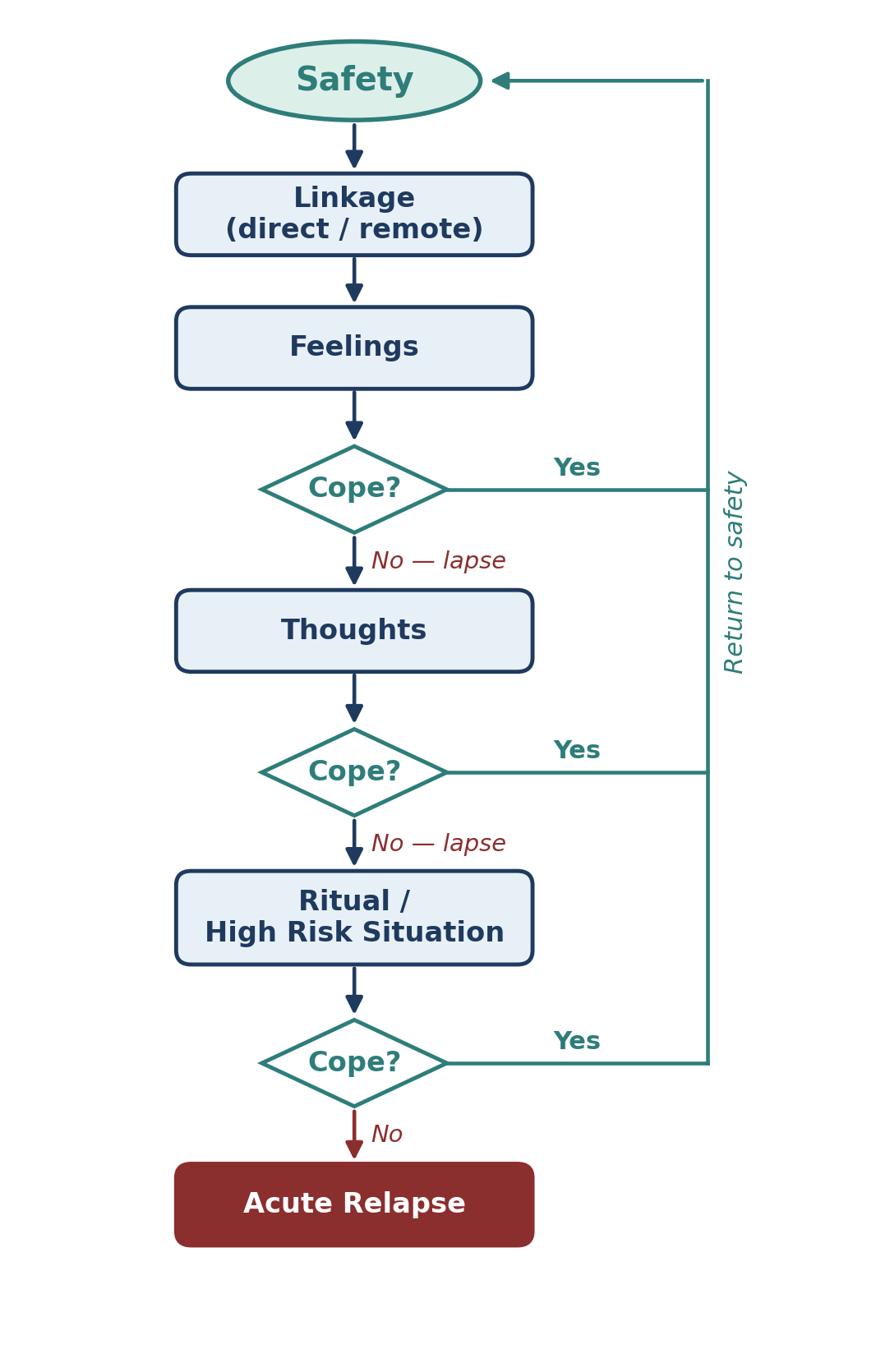
The earlier in the chain a client intervenes, the easier it is. Coping with a feeling takes less effort than talking yourself out of a ritual already underway. That is why relapse prevention spends so much time on feelings and thoughts, not only on the situations clients are told to avoid.
Relapse prevention as a bridge for transfer of learning
Treatment teaches skills in a protected setting. Daily life tests them under pressure, often without warning. Relapse prevention works as a bridge between the two because it is structured around the same steps that help any new learning carry over: personal relevance, repetition, rehearsal, and real-world feedback.
The workbook moves clients through those steps in three stages.
- Identify the pattern (Section A). Clients examine at least ten specific past behaviors in detail: what was happening in their lives, the feelings before and after, the small steps that led up to it, the decisions they made, and the rationalizations that made those decisions feel acceptable. The coping plan is built from the client’s own history, not a textbook list.
- Build the coping responses (Section B). From that material, clients identify their recurring “theme feelings” and “theme thoughts,” their rituals, and their high risk situations. For each one, they write specific, doable coping responses that include accountability. A cost/benefit matrix then compares how they saw the old behavior then, how they see it now, and what the new behavior costs and offers.
- Maintain the change (Section C). Clients map the people they will see every day, how each person might enable them, and how each can support them. They then log real coping attempts each week: what they tried, whether it worked, and why.
The repetition is intentional. Clients often notice they are writing about the same feelings and decisions again and again. That is the point. The goal is to over-learn the new response until it becomes the automatic one. Once healthy behavior is automatic, returning to the old behavior requires a conscious decision, and that moment of thinking is where a lapse can be caught.
The weekly monitoring in Section C is what turns insight into practice. A plan that is never tested is still just a plan. A coping skill that has been tried, failed, adjusted, and tried again is one the client actually owns.
What the research says
Relapse is common, and that is exactly why a structured plan matters. The National Institute on Drug Abuse estimates that 40 to 60 percent of people treated for a substance use disorder relapse at some point, a rate similar to other chronic illnesses such as hypertension and asthma. Relapse is not a sign that treatment was pointless. It is a sign that the maintenance phase needs as much attention as the change phase.
The evidence that relapse prevention helps is long-standing:
- Substance use. A meta-analysis by Irvin and colleagues (1999) pooled 26 studies covering 9,504 participants. Relapse prevention was generally effective, particularly for alcohol and polysubstance problems, and worked best when combined with medication where appropriate.
- Offender populations. A meta-analysis by Dowden and colleagues (2003) of 40 tests found moderate reductions in recidivism. Programs that targeted more relapse prevention components, and that spelled them out in detail, did better. Two elements stood out: identifying the offense chain and training significant others in the program model.
Those last two findings line up closely with the workbook’s structure. Section A is, in effect, a detailed mapping of the chain that leads to the behavior. Section C brings the people in the client’s daily life into the plan. Relapse prevention works best when it is thorough and specific, not when it is a one-page handout.
Research also points to who is most at risk. In a 2020 study of 95 Veterans in residential alcohol treatment, Nguyen and colleagues found that 69 percent relapsed within six months. Three factors predicted relapse: greater anhedonia (difficulty feeling pleasure), active cigarette smoking, and fewer days of abstinence before treatment began. A mood disorder diagnosis by itself did not predict relapse.
Both risk factors fit naturally into a relapse prevention plan. Anhedonia is a classic remote linkage: a flat, joyless stretch that rarely looks connected to drinking but quietly pulls a person back toward it. It belongs on a client’s list of theme feelings, with specific coping responses that rebuild pleasure and reward in daily life. The authors also suggest addressing smoking during alcohol treatment rather than deferring it. In the workbook’s terms, smoking often sits inside the rituals that surround drinking. The sample was small and limited to Veterans, but the lesson is consistent with everything above: the plan should target the specific vulnerabilities each client brings.
Putting it into practice
For clinicians and programs, a few principles make relapse prevention more than a discharge formality:
- Start early. Begin relapse prevention work in the middle of treatment, not the last week, so there is time to practice and revise. Make it an intentional activity for treatment, not an afterthought.
- Build from the client’s history. Generic trigger lists miss the remote linkages that matter most. The client’s own past behavior is the best source material.
- Treat lapses as data. When a client lapses, review which feeling, thought, or ritual came first and what coping response was missing. Then update the plan.
- Involve the support network. Help clients tell the people around them how they might enable use and how they can help instead.
- Make monitoring routine. A regular/consistent review of what the client tried, what worked, and why keeps the plan alive after formal treatment ends.
- Screen for anhedonia and smoking. Both are modifiable relapse risks. Build coping responses for them into the plan rather than treating them as separate issues.
Recovery is not something a client completes. It is something they keep practicing. The written plan matters far less than the process of building it, testing it, and returning to it. Relapse prevention gives clients a way to take what they learned in treatment and make it the way they actually live.
Sources
- National Institute on Drug Abuse. Treatment and Recovery. Drugs, Brains, and Behavior: The Science of Addiction.
- Irvin, J. E., Bowers, C. A., Dunn, M. E., & Wang, M. C. (1999). Efficacy of relapse prevention: A meta-analytic review. Journal of Consulting and Clinical Psychology, 67(4), 563–570.
- Dowden, C., Antonowicz, D., & Andrews, D. A. (2003). The effectiveness of relapse prevention with offenders: A meta-analysis. International Journal of Offender Therapy and Comparative Criminology, 47(5), 516–528.
- Nguyen, L., Durazzo, T. C., Dwyer, C. L., Rauch, A., Humphreys, K., Williams, L. M., & Padula, C. B. (2020). Predicting relapse after alcohol use disorder treatment in a high-risk cohort: The roles of anhedonia and smoking. Journal of Psychiatric Research, 126, 1–7.